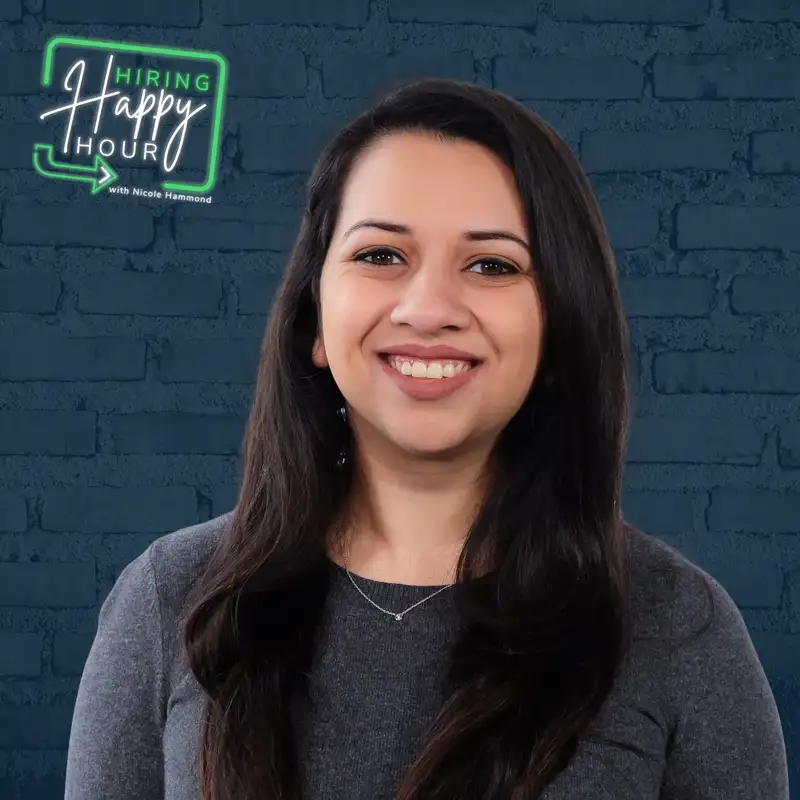
HHH - Shefali Netke
===
[00:00:00]
Nicole Hammond: Hi, everyone. Uh, welcome to another amazing episode of Hiring Happy Hour. I say amazing because this guest is truly that. I've worked with her for quite some time, and she is someone that I look up to, just how amazing she balances the work, but also her people. [00:01:00] Um, so we're gonna learn a lot from her today. She is a rare kind of design leader, one who treats user empathy as a discipline, not just a buzzword. She builds hiring products people actually want to use, and we have the data to prove it, from a cognitive science background most designers don't have. spans two continents with a mandate that's simple on paper and hard in practice: make enterprise software feel human. past year, she's led her team through a full rebuild of SmartRecruiters' design process to keep pace with AI and help steer the org's integration with proving scale doesn't have to slow down innovation. VP of Product Design here at SmartRecruiters, please join me in welcoming Shefali Netki. Welcome to the show, Shefali.
Shefali Netke: Thanks so much, Nicole, and thank you so much for having me. I'm excited to dive in today
Nicole Hammond: I am excited too, because I think design is a core piece to adoption, and you are so [00:02:00] darn thoughtful, and like the intro said, you just bring an element that I don't think many design leaders have. And so we're here to share that wisdom. So we are going to dive right in, and I want to hear from you more around your hiring happy hour.
Um, what does that mean? It means that moment, uh, during your career that you're proud of, that you made an impact that our audience and listeners can learn from
Shefali Netke: It's a tough one. We've had a lot of good moments here, but I think the one that probably stands out the most is our big sort of pivot and Winston launch a couple years ago. I think this was such a important time for our company and in the industry, and it was one of those moments where we said, "Hey, what has gotten us here is not, is, not what is gonna get us ahead in the future."
And took a moment to say, "How do we change our foundation and ways of working?" And take a deep look at our [00:03:00] roadmap and say, "Okay, what do we do? Like, how do we mix things up? How do we jump ahead?" We did a lot of really deep user research, which was great. Spent a lot of time with customers, and spent many, many sessions diving in, asking follow-ups, testing wild ideas and, really throwing it out there, and then seeing what stuck and how to get ahead of the AI wave that was coming, and now that we're well underway in that.
But I think it was, is a really great opportunity to dream big, think ahead, and then actually deliver on that within the year. I think it was a great moment for the team, for the company, and, um, a really exciting way to jumpstart our product again and rally around something and have, uh, bring some sort of fresh life back into a product that several of us have been working on for a very long time.
So it was a very exciting moment, um, a really fun launch as well, and a really collaborative effort [00:04:00] across the whole company, and I think that was, uh, a really, definitely a really proud moment for me
Nicole Hammond: I, I, every time someone talks about this, I get very excited, and I remember back to this moment, and I was on site with a customer this week, and I shared with them about this moment. And there's always an initial reaction when your leader tells you, "Guys, we're gonna drop everything and we're gonna shift to be an AI company," right?
And that first impression, you're like, "Oh my gosh, this is insane." But it's quickly followed by, "Yeah, let's do it. This is the team to do it," right? So to your point around collaboration, the right leaders in place that have so much passion
and wanna get ahead of the curve so fundamental. Um, and I think the most important part, we think about analysts, right?
You have people that are visionary versus execution, and top right quadrant is both,
Shefali Netke: Absolutely.
Nicole Hammond: We have proved [00:05:00] that. You know, it's not only just us saying it, but others out in the market,
and then adoption of Winston, right?
60% the jobs touch Winston across all of our customers. That is not an easy feat, and he's only two years old.
That is amazing. So tell us about your team. Tell us about this process. we have organizations out there that they are excited or thinking about transitioning to an AI organization, or even just making it a fundamental part of their core, from a design perspective, what, where do you start?
Shefali Netke: Yeah, absolutely. I think for-- There was the Winston launch in particular, which was a really big focus for us on Research, diving in, and mainly creating the time and space to do that. So, and it's something we've been doing this year as well, and it's you continuously do it with the pace of our industry right now.
Um, you don't [00:06:00] do it once. It, it keeps going. So I think that was maybe like our bigger motion, but we've done other versions of it. And I think what has worked really well for the team is giving them that time and space to do it, 'cause folks are really eager. They wanna learn, they wanna dive in, they want the product to be better, they wanna increase their knowledge, but it is hard to do that, like, on top of everything else.
And sometimes that's what people try to do, try to, like, add it on or, um, do it in addition or, um, everything feels important and urgent, and this is one of those other things. And in reality, you, you really need to create that space. So whether it's, you know, clearing a week if you can pull that off, or clearing a few days or even a few hours where you excuse everyone out of all their meetings and say, "Hey, we're really gonna focus on this and, and learn together," or, you know, bring in a speaker, whatever it may be.
And then having that space for folks to come in and engage and giving them the tools I think [00:07:00] makes a really big difference and really worked well for us. It worked well on the company scale in terms of our roadmap and also more recently just in terms of increasing our AI fluency in the organization, and that is...
that's the biggest one. It sounds really simple, but just giving people time and space. And then I think from there, also letting folks know that it's a journey, right? You can't learn everything all at once, and even if you do, the next day there's another 20 things, right? You can't even keep up with all the tools.
It's, it's impossible. It's, it's a bit of a, a fire hose moment for sure. So letting people know, you know, it's not about catching up and learning everything. It's just getting comfortable with the language and the processes and practices and also acknowledging we're all figuring it out together. No one's solved everything.
Um, I think we, we had a previous conversation. We were talking about how the, I think for design and honestly for tech overall, we haven't had such a [00:08:00] massive industry shift in a decade, right? Um, in design, you know, we've, there's obviously big waves with design systems, um, and more collaborative tools and things like that, but nothing to this scale in, in a very, very long time.
And I think having people, you know, feel that, the importance and urgency without freaking them out, right? So like how do you make sure it's an interesting and exciting thing and not, um, you know, a scary, "I'm falling behind. My role is, you know, risky," sort of a, um, a piece, and it's driven by that excitement and not fear is, is super important
Nicole Hammond: And you are one of the best at this as a leader, right? I think you share with our audience that they need to give the space and time, but you have done an amazing job of also assuring your team, "Guys, we're all learning together, and don't worry, like, we will all learn from our mistakes. We will build together.
Like, transparent [00:09:00] communication is going to have us all rise together." Which I feel is so important in this time with AI, because you're right, we don't wanna scare people. We don't want them to work in fear. Um, and we want them to feel that impact, and it has been there, right? We've seen it. And the other piece to this is we continue to elevate it, right?
Winston wasn't just a one-moment launch.
It continues to innovate with AI across the system, with AI for different users. Um, speak to the creativity of your team, right? I've seen it. I've seen it in when we create roadmap or just ideas for three-year-out strategy and collaborating with you guys. Some of the stuff that they come up with is absolutely phenomenal, mind-blowing. H- how do you not only make the time for them to think, but, like, continue to spark that creativity?
Shefali Netke: Mm-hmm. Oh, that's a great question. Um, I think, you know, part of the design discipline, [00:10:00] so many folks are rooted in creativity, which is amazing, right? There's this sort of like inherent leaning towards that, which is great, and I think it pairs well with our function and how we're placed in R&D orgs, and it's one of the main reasons that, you know, we feel in our role it's, we really champion human intent and interaction and, and all of this, right?
And a part of doing that and getting folks to rally around it is making it very visual, right? And it's, it's one thing to read a doc and digest and, and try to see from there or, you know, go through a deck, but seeing the North Star or the vision or, like, dreaming and actually being able to look at what the art of possible in the future just has such a different impact.
And you know, when I, we talk to designers about this, it's very different if you give someone, you know, um, a specific, [00:11:00] um, requirements document and they just design for that, or it tends to lead to very restrictive thinking if that's all that you do. And it's very different to say, "Okay, this is your solution.
Now, you know, maybe take it a notch further, maybe one more further." And, um, your anchor is already set low, I would say, or less creative, versus if you really throw it out there and say, you know, "Go all the way, and then we'll reel you back in," right? Like, I would much rather reel folks back in than say, you know, "Push a little more."
Like, what else could we do? What else could we do? Um, and I think being able to, you know, always have some sort of forum or exercise or practice around, you know, doing that more, like, crazy idea or reaching out there is so important to just keep that muscle going. So, you know, we do it on a bigger scale maybe once or twice a year, but there's always little versions of it happening, right?
Like, try out the idea, sketch it out, or now, you know, just even, like, quickly code it up, which is great, um, [00:12:00] and share it often. I think, like, share ideas early and often is a really big one, where that is the time to
Nicole Hammond: Yeah
Shefali Netke: and think about things differently and really encourage that. And then I think another thing is not restricting your creativity to your specific work that you're doing, right?
Um, and always, you know, encouraging conversations about, you know, art or culture, like, whatever it may be. Um, you never know where your next idea could come from, and I think it's so important to have, you know, diversity of background, diversity of thought, and even from diversity of inspiration, right? Is, is super important as well.
And I think there's so many different sources of creativity that go even beyond, like, the traditional design ones that everyone can connect with and use.
Nicole Hammond: That's beautiful. I think that is such a testament to you, Shefali, so I, I, I, I love that. I [00:13:00] wanna talk about vision becoming reality, because you spoke to this, I've spoke to this,
and you spoke about collaboration. But I wanna share with our audience if they're, again, thinking about taking this next step to make vision reality, what does that collaboration look like?
What are the priorities that you have with the other major departments or people that you work with?
Shefali Netke: Yeah, absolutely. Um, it can be super scary to put out a vision, right? And it's, it's a lot of pressure and, um, it's a bold statement, right? And I think what's really critical there is that it's, it's grounded in reality, right? Like we're not just ... Maybe early ideas just dream, you know, no restrictions.
Divergent's fine. Um, but when it comes to what we converge on a bit and say, "Okay, this is our anchor vision, and this is what we're maybe, you know, showing to users or, uh, circulating a little bit more," that all comes from our research and like all the discovery we've [00:14:00] done and the roadmap ideas that, you know, there's always a couple ideas someone's been sitting on for a long time, be like, "Man, I really wish, like if you gave me a couple teams or I would just go for it."
Um, so there's, yeah, I'm sure I know you have a list somewhere, Nicole. Like a lot of it stems from that. Some are more of a reach, and I think sometimes folks hesitate because they feel the pressure of, "Okay, I'm putting out this vision. I need to deliver on 100% of it to the T."
Um, and I think that defeats the purpose, right? The vision is not supposed to be 100% accurate. It's not possible either, right? Things change, tech changes, industry changes. Like you need to keep it adaptable. Um, but the point of that vision and taking that big step is to have that anchor story. And I would say, you know, 80% of it should be pretty accurate and, you know, on point.
There could be visual changes, maybe a workflow here or there, like how you actually go about the experience. So I would say keep it a good [00:15:00] amount of it rooted, right, in reality in what you're gonna do, and you should feel quite confident about that. But be flexible on how you get there. And when you're talking about the vision, it should be about outcomes and the story, not about this is how this feature works and this feature is really cool, right?
Then I think you're losing the, the point there, and you're putting yourself in a bad spot because, you know, then you're held accountable to features, which is not a great, I think, way of operating. It's more about are people along for the journey and the story. Because even from a customer user perspective or whoever you're catering to, um, once you meet the features, then they're like, "Then what?"
Then like they're not on a strategic vision journey with you either. But if you're thinking bigger picture, they can also dream ahead and think ahead and, and plan for their orgs.
Nicole Hammond: Yeah. And be part of that. I love that. I love that. All right, now we're gonna talk about a fun topic and the acquisition, and now being part of a larger [00:16:00] organization. Um, I think the beauty has been you've now started to work with different parts of SAP SuccessFactors to share. But to us about scale, talk to us about enterprise, talk to us about impact that you and your team are having within this larger ecosystem
Shefali Netke: it's been wonderful, like a really, really good experience, um, now getting to step into this much larger world. So it has been very cool to see what we do having such a large impact, right? We reach several more people. Our customer base has just exploded in the best way, and it's, it's great.
And I think there's a couple different things. One is what you mentioned, like the scale is very different, right? So there's different nuances to consider. There's just like exponential numbers to keep in mind. Some are very tactical, and some is how that experience scales and [00:17:00] what it looks like. And I think the, the trade-off there or the balance is making sure we don't get stuck in the, "Oh, now we need to do more things 'cause there's more people, and, you know, we need to figure all this out."
It's more about, okay, maybe we do ... Do we actually maybe need to do less things but better that can impact more people? Or we do the same things in a different way for these particular industries? I don't know. But scale doesn't mean things slow down or you can't innovate. I think those are not
They're, just sort of like statements to hide behind or fall back on because in reality, it should help you unlock new avenues. I think it might look different from what you're used to, but that's a good thing, right? that means you're moving forward and things are changing in a different way.
I think what's been really interesting for us and we'll continue to see is operating in a bigger ecosystem, right? So like how does our, product integrate? What does that look like? our [00:18:00] SAP has a fantastic central design team, and they have a much bigger SuccessFactors design team.
those teams have different ways of working and thinking about things, which is good because it challenges us, and it's not about, you know, our older way of working or their way of working. It's what is our new way of working together? Like, this should always be evolving, and I think that's been really fun to sort of challenge and see what works well.
And, you know, if, if theirs is better, let's do it that way. If ours is better, let's do it this way. Or if we find something together, let's go for that, which is great. So I think that's been really good. Um, and then also being able to lean on the wealth of knowledge and enablement expertise, which is, yeah, fantastic and, and really cool to be able to unlock that and, you know, approach this problem in a lot of different ways.
And we're all You know, on the same team working together towards these really big challenges. Um, and yeah, I think it's, [00:19:00] it's been really great overall from that perspective. Um, and again, another change, which is good to figure things out, um, question some of our processes, and then think about a different way of building.
And I think especially in this time, and for a designer in particular, there's a lot of changes in how we're doing user experience design, right? Like, there's been traditional interface design. There's been a lot of conversational design recently with, you know, um, any sort of conversational experiences or agents and things like that, and we're slowly moving into the generative design world as well, where UI is just being created on the fly and, um, also, like, really interesting for figuring it out, right?
Like, it's, uh, it's, it's really cool to have a bigger team who has, you know, some of that structure and ideation around it and [00:20:00] that support. Um, and I think that it's, it's a really, like, cool moment in the design industry to think about these challenges again, and being able to do that in a bigger space is, is really nice.
Nicole Hammond: I think you are a change manager's dream with how glass half full you are on these experiences, but everything you're saying and makes collaboration better, right? To look at it as an opportunity, to find the ways to collaborate, to be in a space where you trust each other, to take the best of either worlds. Um, so it is exciting times. And then to your point, all the resources, the data, the people, the enablement, the tools that you have at your fingertips. I want us to end a little backwards, because most of these conversations you start with, like, strategy objectives, like h- how did you get there, right?
Shefali Netke: Mm-hmm.
Nicole Hammond: I wanna talk about the future, and I think that you have such a beautiful brain when it comes to design strategy and knowing, based on all the research you and your [00:21:00] team have done, of where the world is going.
Shefali Netke: Mm-hmm.
Nicole Hammond: Speak to our audience, for those of you that are also ahead of the curve and are innovating and executing and looking at this new world of agentic or autonomous enterprise, share with our audience, like, what are the fundamentals of that design strategy, and how are you, are we, are we approaching this?
Shefali Netke: Yeah, absolutely. So I have three big pillars for our design strategy for this year. The first one is around agent coherence. So what does the agentic world look like, and especially what does it look like from an end user perspective, right? So it's not simply about building like we have 50 agents, we have 100 agents.
Like sure, great, but do they all have a similar user interaction? Um, does the user feel like they're talking to 100 agents? 'Cause that doesn't sound fun, right? Like
Nicole Hammond: No
Shefali Netke: should just have one consistent experience, and it should be, you know, done really well. So how do [00:22:00] you scale quality of those experiences?
How are you checking on that quality? What does that look like? 'Cause again, it's very different from traditional design that we're more used to or have more practice with. So this whole first pillar around how we build good quality agent experiences is, is a really big one. So fundamentals on understanding that, making sure the end user experience is really effective, I would say is our first big pillar
Nicole Hammond: Okay
Shefali Netke: Second one is around, intent-driven experiences or intent-aware experiences.
And this is, you know, gonna sound really obvious when I explain it, but I think it's just so important in this, uh, time in our industry, and that is making sure all of our experiences are driven by human intent. So like everything is anchored to real problems that people are having, right? Um, challenges, real needs, and that is the reason we're building [00:23:00] something out and driving it.
And I think, um, what I've been seeing a lot, and I, I'm sure everyone hears this, is there's a lot of push for speed, like building things faster. And as a consumer of products, like you gotta learn everything, like figure it out real quickly, like learn all these tools. And I think there's a lot of pressure on an end user actually to ramp up quickly, like you gotta use AI for all your work and all of this.
And I think that there's the responsibility on the other side for anyone designing products to actually make AI usable for humans, right? It's not just that humans need to learn AI, it's that AI needs to know how humans operate. And I think that one is where that intent-aware pillar comes from, where it's like, don't remove humans from the equation.
Don't get so wrapped up in, you know, this hype and, speed and whatever it is, and forget the core of what we're doing. And also understanding that your customers are probably on different [00:24:00] parts of the journey, right? Because, you know, maybe you are using AI pretty heavily in your workday, not everyone is, right?
Whether, you know, that could be because they haven't learned yet. It could be 'cause there's, you know, various restrictions on their tools, like you don't know. And you need to be able to take anyone on that journey. Like they could be at the start and early, they could be further on, but they should be able to engage with your product.
You can't only take one of those groups to move forward. So just being very aware of the human context is that middle pillar. And then, um, the third one is how do you scale trust, right? So trust manifests in so many different ways. You can build trust visually through interfaces that are, you know, recognizable and patterns.
You can also build trust through legal compliance and legal requirements, right? Like we have to, you have to be super careful. and these other two pillars and everything else just, it really collapses without trust, right? If people aren't, don't trust the outputs or if it's not [00:25:00] compliant or, you know, there's lawsuits popping up here and there, then it just, it takes away all the value, right?
So making sure that is always critical, built-in part of early part of your process, making sure that's taken into account, otherwise it undermines everything. and being able to do that at scale, right? So there are different personas and users that you build trust with, and it's different in different ways, right?
Like admins generally are more aware of the compliance side. They need to be really careful, um, for maybe a more higher volume of our end users if we're showing any sort of, you know, AI summary or intelligence, they should, you know, trust that that's accurate and helpful for them, right? There's a whole range to this, um, and different ways we can do that.
And then even in scaling, um, with like for us, like integrating our software, like moving from one experience to [00:26:00] another, it shouldn't feel like that. It should just all be one experience, right? So how do you scale it from an interaction design point of view as well? So this is the, another really big one for us and a pretty consistent one, right?
We, we typically keep some version of this like very top of mind as we product
Nicole Hammond: These are great. I think, again, to repeat for our audience, agentic experience, um, intent, right? That human component and for adoption purposes and scale with trust. It, it's core. It's core. If I'm in TA or I am an HR business partner and I wanna learn more of what my design team is doing, could be that initial question or conversation that I could have?
Because I think a lot of our audience is across HR TA, but this is important as we think about where the world is going and adoption, engagement, and usage of the technology that we are either [00:27:00] building or using.
what can they say? What can they ask?
Shefali Netke: Yeah. Well, I would say almost all design teams are always doing research and testing, so I think that's actually a very easy, quick pathway to engage with that team and say, you know, "Are there any ideas that I can look into?" Or, "Do you need testers?" or giving some insight on a topic that they know a little bit more about.
And finding ways, I think, to engage earlier in the process is always really cool for teams, like internal teams especially, 'cause, you know, you get a sneak peek in and you drive some influence, and it, really helps to have that safe space. So I think that's one way to engage, like go earlier in the process and ask, you know, "What's up and coming?
Um, can we get involved in research?" And then I think later on is, and just being curious about the product and asking questions, right? Like if you see, [00:28:00] um, an interaction that you really like and think there should be more of, if you're have an idea, share it with the team. Like we always love hearing ideas from,
Nicole Hammond: Yeah
Shefali Netke: internal, like you're in it all the time and, you know, it might vary by company and what that looks like, but I think it's, it's always great to have that.
Or even on the flip side, if something's like, "Ah, it's... I don't know if this is working really well," or it's, you know, "This is kind of annoying," you're well positioned to, you know, talk to the team and, you know, obviously be nice and respectful about it. But, um, I think it's always, um, that's another good avenue and overall it, it really comes from, as it would with any function, like showing interest in their craft and work, right?
So I think using that as an anchor is, is always great.
Nicole Hammond: I love that. Well, you heard it here. Um, Shefali, you are a wealth of knowledge, but always with the best intent, so thank you for this. Well, we wanna learn more about you. Who is Shefali? [00:29:00] Um, and so we're gonna switch to your personal happy hour.
Shefali Netke: Okay.
Nicole Hammond: of work, um, what brings you joy? What brings you balance?
What makes you smile?
Shefali Netke: High level, s- spending time with my community, family, friends, loved ones. I think that is, that's really what fills my cup. Um, but on the flip side, as someone who's naturally more introverted, I do love reading. Um, I, I have my cozy spaces at home. Um, so reading, art, anything that, you know, gets that creative side of my brain going and that flow and focus time, I love.
Um, I also play the piano, so I do kind of that as well. So yeah, sort of the, a balance of these things. Um, and then, you know, a, a, an obvious one that I know you will definitely relate to is s- spending time outside, you know, fresh air, nature. Um, I always, uh, I've always [00:30:00] lived near the water. It's like one of these things that is, um, just helps, you know, keep me connected and calm, and it's just so beautiful.
So, you know, going for walks and, and spending time outside is obvious but underrated
Nicole Hammond: I love it. right, our last one and a fun one, and, um, it's called this or that, and I know you're familiar with this. You choose one, you choose both. tell me why. You don't tell our audience why. You can choose your own adventure.
Shefali Netke: Sounds good
Nicole Hammond: so we've made some of these relevant to design, um, and hopefully these resonate with you, and then we go into some fun ones. You ready?
Shefali Netke: All right. As ready as I'll be. Let's see.
Nicole Hammond: Okay. Um, chat-first experience or UI-first experience? I started hard out of the gate.
Shefali Netke: Really did. Um, man I might go chat, and it's probably biased because that's how I operate right now. So I will, will leave that caveat. [00:31:00] Um, but I will say don't, uh, nothing's 100%. There are some cases where UI is absolutely needed, but I think, um, chat is a very interesting world and actually a very human way to interact.
And a lot of times I actually am not typing, I'm voice dictating, which is very natural. Um, so yeah,
Nicole Hammond: Okay.
Shefali Netke: That's my, take.
Nicole Hammond: I might start doing that. Um, agent takes action or agent recommends the next action
Shefali Netke: I would say the majority of the time agent takes action. I think folks, um, underestimate how much can just run on its own and then protecting when it should ask you or recommend an action. But there, there's a lot we can hand off and free up your space to think about other things. So I would be more bullish on takes action.
Nicole Hammond: , personalized interface for every user or [00:32:00] standardized enterprise experience?
Shefali Netke: Personalized for sure.
Nicole Hammond: Design system first or AI flexibility first?
Shefali Netke: I would say design system first because I think you actually can't have AI flexibility without the design system. It, that's what gives you the ability to scale to do all of those experiences. So I would go design system first.
Nicole Hammond: Okay. Design the workflow or design the guardrails
Shefali Netke: Oh boy. Uh, I'm gonna get in trouble if I choose-- If I don't choose both. I think it has to be both. Um, yes. I, I mean, I would say, yeah, start with the workflow. Make sure you have the guardrails.
Nicole Hammond: Yeah. It was so funny, one of my girlfriends was like, "Yeah, I was talking to ChatGPT, and they just keep giving me nice answers." I'm like, "Yeah, it can't really say a bad word to you. It's called a guardrail." Like not allowed. okay. Build the smartest AI or build the AI people [00:33:00] will actually trust enough to use
Shefali Netke: Definitely the second one, I would say, trust enough to use, because I think we're also in such an open ecosystem now that you can leverage the smartest AI. Like, you don't need to be the one to build it for every use case. But if you have the smartest one and like it's not useful, no one's interacting with it, then what's the point?
Yeah
Nicole Hammond: I like that answer. All right, now easy one, funs ones. We're done with those, but,
Shefali Netke: Okay.
Nicole Hammond: I, I learned. I loved that. I loved that. Uh, vacation or staycation?
Shefali Netke: damn, I really like both. Uh, I'll go vacation.
Nicole Hammond: we already heard this one, but mountains or ocean?
Shefali Netke: Um, I, I would say ocean, but, uh, being a native Californian, we do get a lot of instances where both are possible, which is a privileged thing. Um, so, but yeah, I, I'll go ocean.
Nicole Hammond: Okay. or sunset?
Shefali Netke: [00:34:00] Ooh. Um, Sunrise
Nicole Hammond: Okay. And I threw this one in because you've recently made a move back to California. Coast or West Coast?
Shefali Netke: Oi. Uh, I, I gotta go west. Um, but I, I, I do love the East Coast. I spent a long time in New York. It's fantastic, but, um, it's lovely to be back home. So I... West Coast is wonderful. I'm happy to be
Nicole Hammond: is the best coast, right?
Shefali Netke: Sure is, yes.
Nicole Hammond: with us, but I agree with you. Um, and then coffee or tea?
Shefali Netke: tea, although I have a lot of both I will say
Nicole Hammond: Yeah. And then final one, beer, wine, or spirits?
Shefali Netke: Ooh. Um, probably wine for me
Nicole Hammond: Okay. Well, cheers Shefali. This has been so fun. Uh, share with our audience where they can find you or connect with you if they have questions
Shefali Netke: you can, I think, find me on LinkedIn pretty easily. [00:35:00] Otherwise, shefalinakade.com is up. That's probably the easiest way, and all my links are, are from there. Um, yeah, happy to chat about the, you know, HRT world, about design. Um, I think it's good to continue the conversation and, um, always be open and learn from one another.
There's so much going on right now, and as I said, we're all figuring it out together. So yeah, happy to, to hear from anybody.
Nicole Hammond: Yeah, and please take her up on it. She is one of the most inviting humans I know and a brilliant mind in this organization and beyond. Um, thank you Shefali for being here and spending time and educating me and our audience on now and the future when it comes to design and agentic. Uh, everyone, this has been another fun episode of Hiring Happy Hour.
I hope you learned, and if you are in the TA or HR space and you do know individuals in your design, I challenge you to be curious. I challenge you to ask, um, because I know that they [00:36:00] will want your involvement, um, and the collaboration will do amazing things for your organization and beyond. Um, but thank you again for being here, Shefali, and thank you all for joining us.