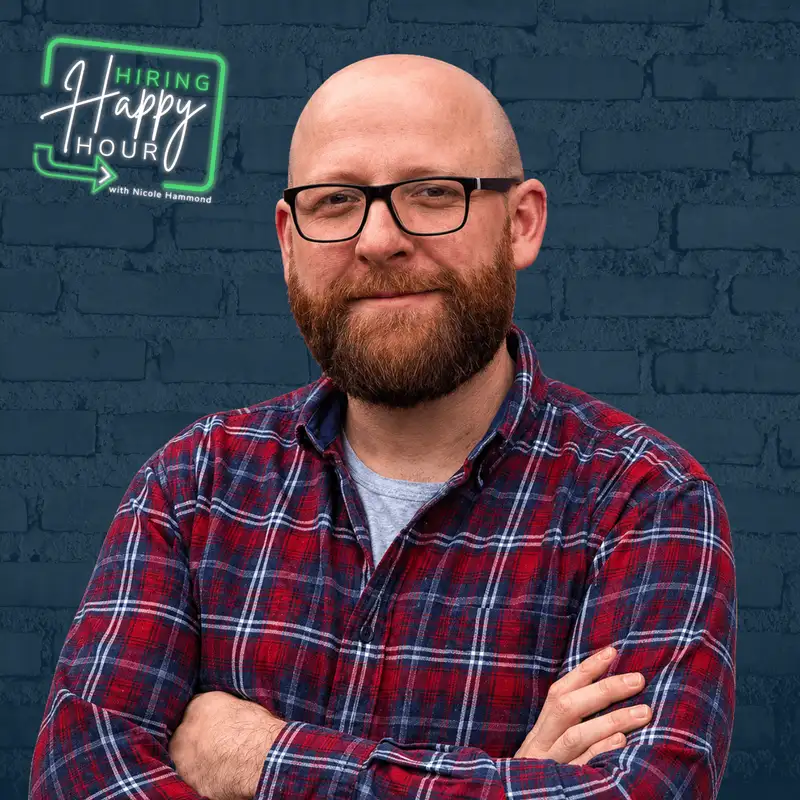
HHH - Alan Walker
===
[00:00:00]
Nicole: am excited about this first, meaning my first CEO. So Alan Walker is the co-founder and CEO of Udder, a TA technology consultancy that helps organizations turn ambitious ideas into practical working solutions. With a [00:01:00] background spanning TA technology and transformation, Alan has spent the last decade working with global organizations to make TA tech actually, actually deliver value for the people who use it.
He is known for his straight-talking approach, his ability to bridge the gap between vendors and customers, and his belief that good technology s- should simplify work rather than complicate it. His team's work spans a wide range of organizations, from high-growth scale-ups to global enterprises, including major names like Primark, Novo Nordisk, the BBC, and Royal Mail.
When he is not building Udder or talking shop, Alan is usually thinking about leadership, responsible growth, or explaining football loyalties to his children. Love that one. CEO of Udder, Alan Walker. Welcome to the show, Alan.
Alan: Well, thanks for having me on, Nicole. It's great to be here. First
Nicole: Ah.
Alan: but you know, it's a low bar. You can only go up [00:02:00] from here.
Nicole: Where do you go from there?
Alan: a bigger, better CEO.
Nicole: There we go. Next time we have you on, we're gonna say, "We have a bigger, better CEO on the show today."
Alan: I like it.
Nicole: I do too. I do too. Alan, I'm really excited to have you here. Uh, SmartRecruiters has been working with Udder for quite some time, and the relationship, I will say, is one that is very strong and very collaborative, which I think is very key to success.
Um, but that's not why we're here today. We are here to hear from you. Uh, and so I want you to share with our lovely audience, our friends that are listening and their friends that they're inviting to listen, around what your hiring happy hour is.
Alan: Interesting question. I,
Nicole: Okay.
Alan: This and, um, it's something I had to think about quite a while actually, because I've been in the TA space and recruitment space for 20 odd years, and I've been a hiring manager as well, and I've been a candidate, and all of those roles, [00:03:00] as well as being a a recruitment leader. Um, but I think what's, what's really made me happy over the last decade or so, and I think the thing that's really inspired me, was actually creating Udder. And not because it's a business and I'm all excited about building up this enterprise and everything that goes around it, um, but how we built it. Um, we, we started the business in December 2019 with just a few hundred pounds between us, really, me and Jeremy, my co-founder. We didn't have a, a huge investor behind us or a whole heap of cash to burn through or anything like that. We set off knowing that we'd have to make this work organically. It would have to, have to be profitable from day one. Um, what we didn't know at that point was that we would be starting the business three months before the global pandemic, was a bit of a surprise. [00:04:00] Not really a thing most people plan for in the grand
Nicole: right? Mi-minor hurdle. Minor hurdle.
Alan: Yeah, that was a bit of a surprise. So there we were in December, all excited. January, February, did a few projects, won a few clients, and then March we had our, our tassled-haired prime minister, um, on screen saying, guys, you're gonna have to all stay at home and not leave your home for we don't know how long. Could be a few days, it could be a few weeks, it could be a few months. but there you go. So kind of crack on and, and deal with it." And we, we were like, "How do we deal with this? What does it
Nicole: Yeah.
Alan: Mean?" We didn't know that lockdown meant suddenly tons of people were gonna be furloughed at that point. We didn't know that suddenly HR folk were gonna go from a team of 100 to a team of one, with the CHRO being the last person standing.
Nicole: Yeah.
Alan: Kinda get the vibe quite [00:05:00] early on that maybe hiring was probably gonna slow down a little bit. And, and hey, it slowed down massively of course.
Nicole: Yes, you did.
Alan: But what we were thinking at that time is what's the impact on, on us. You know, is this gonna curtail our business three months out of the blocks, and we're already... we've already failed, not through our own doing necessarily. So all those questions were, were running around, and it was quite scary for the first couple of months or so, definitely
Nicole: Oh, I would say so. Uh, my husband also started his business as CEO and founder around the same time, and what goes through your head with uncertainty is probably a lot of things that are positive and negative. But I mean, you're still here, and so the positive prevailed. The stubbornness, in my husband's case, prevailed.
The creativity and pivot prevailed. And so tell us, tell us, tell us what happened.
Alan: Yeah. So yeah, we, we have prevailed. Obviously, six [00:06:00] years later, we're still here. Um, what happened was that a bunch of TA leaders and a bunch of HR leaders, um, they realized that when they don't have much HR-ing to do and much hiring to do, actually that's a great time to start looking at you do those things,
your Sure.
your technology that underpins it, um, because you have some time You're, you're no longer having to build the plane as it's about to take off. You've actually got time to park it up and think about these things and actually build the, the, the right kind of plane. helped, why it helped us is that TA leaders were going, "Okay, I want to do something. I want to swap out my ATS.
I want to improve my assessment process. I want to look at how we do onboarding, but I am one single person because I'm the last person standing. Everybody else
Nicole: Yeah.
Alan: Furloughed,
Nicole: Yeah.
Alan: And suddenly we
Nicole: You're [00:07:00] like...
Alan: improving processes, searching for and implementing technology, et cetera. And we've, we've got some capacity." So suddenly we were having quite big organizations come to tiny little Udder then, which was just two of us, saying, "Have you guys got some time? Can you come and help us with this stuff? 'Cause I've got me and nobody else, and we'd love an extra pair of hands." So we went from like day one, two, three, four, and five post-lockdown notification from Boris Johnson, me crying myself to sleep most nights thinking, "What the hell am I gonna do?" To actually going, "Hey, this is looking pretty good. This is okay. This is not bad." we were... like, um, Veolia and BBC were getting in touch,
Nicole: Wow.
Alan: and picking up projects that probably we wouldn't necessarily have got in a normal competitive environment because a lot of our competition, the big, big services [00:08:00] firms, the big RPOs, et cetera, they'd furloughed half their staff as well. Whereas we were there to go, "Well, we can make a decision really quickly. We can sign papers. We can crack on with the project next week. We can knuckle down and deliver something for you in a matter of
Nicole: Yeah. Yeah
Alan: and people were going, "This is amazing." And it kind of set a precedent for how we ended up working all the time.
Fast-paced, energetic, lots about, all about delivery, all about output, no procrastination, all about pragmatism, and it worked really, really well.
Nicole: There's something to that, right? There's something to being a two-man show growing, and we'll talk about that in just a second. But the trust, right? You are not only the leader, you are the strategist. You're partnering with them on their strategy, but you're also the doer, the executor, right? So you have a lot of accountability on your shoulders, and when it's your own company, by golly, you're not gonna let that fail.
Alan: No.
Nicole: Share with us the successes, right? Now Udder is how many? How [00:09:00] did you get there? Tell our, our fans, I'm gonna call them fans because you know what? I am a big fan of an organization where the CEO was, I wouldn't say on the bottom, but the doer in the company, right? You've basically built your way up i- in this and built it out.
Tell us the secrets. So if there's anyone out there that is wanting to start their own gig, right? Like, I mean, I've even thought about... Well, I used to be an independent consultant, but never thought, started my own business. But, but in that same right, you have to sell yourself. You have to sell your value, and majority of your work comes from referrals.
So tell us about the growth and success of Udder.
Alan: I love being close to the work, and I'm not as close to it nowadays as
Nicole: Sure.
Alan: um, kind of hands-on. But I also-- also made the decision early on to be hypercritical of the things we're good at and the things we're not so good at.
Nicole: Sure.
Alan: Good, look at bringing in support for [00:10:00] that. 'Cause we
saw, we always saw those things where we're weaker as being things that would prevent us from scaling. So if we can hire people to either do the things we're just not great at or we don't enjoy doing, because those two things often overlap in a Venn diagram anyway. Um, and we can get people to do those things because they bring an extra degree of experience or professionalism or rigor or whatever it might be that's gonna appeal to a client. It was all about delivery at this time, and we should hire quickly. Uh, and our very first hire, um, was Peter, our head-- now head of, um...
Sorry, our now COO, um, formerly head of implementation, um, Peter Hetherington. And, um, we brought him in 'cause we-- one of our early clients, we'd helped them select ATS, HMR- HRIS and LMS at the same time, and they needed implementation support. At this stage We hadn't made the decision to do implementation work.
We were still a consultancy, helping people make decisions, helping people choose tech, and then stepping away and [00:11:00] letting them crack on with the, the implementation. But we had one client who said to us, "Thank you for all your help. It was amazing. We've done nothing since we chose the three systems."
Nicole: Oh, no.
Alan: that's interesting.
So you need more help?" And they're like, "Yeah." "Okay, leave it with us." And, um, one of the systems we chose, and this isn't a pitch fest, was SmartRecruiters. And, um, SmartRecruiters was the right system for them, and SmartRecruiters had done everything possible to help the client, um, with the implementation.
But the client wasn't receptive, shall we say, wasn't able. The business as usual was taking over their life.
Nicole: Sure.
Alan: to the client, "Look, if we can find you someone to help, be useful? Would that be helpful?" they're like, "Yeah, yeah, sure. That'd be great." then we asked the SmartRecruiters crew, did they know anyone?
They said, "We've heard of this guy called Peter. He might be available." went, "Right." Chatted to Peter, hired-- literally hired Peter almost the next day and
Nicole: Wow.
Alan: go and help this client, and [00:12:00] then we'll see where we go afterwards, and we'll see how that pans out." panned out to six months later, this is a continuation of the story. SmartRecruiters going, "That guy who's been doing implementations for you, he's amazing. Would you like some more work?" We're like, do-- does this work that you just go, 'Here you go, Udder, do this work for us?'" They were, "Kind of." We're like, "Yes, we like that kind of work.
So by the end of year one, we were at five people. The end of year two, we were at, I think, 10 or 11.
And
Nicole: Wow.
Alan: to where we are now, and we're more than 30 people, um, in 10 different countries doing our work in 10 different languages. delivered over 600, HR technology implementations, over
Nicole: Wow.
Alan: of hundred of SmartRecruiters ones as well. Um, and it's been a, it's been a... I wouldn't say it's been a, an amazing ride all the way and it's been easy. It's been a roller coaster.
Nicole: Sure.
Alan: goes through that,
Nicole: [00:13:00] Sure.
Alan: great fun all the
Nicole: Yeah. Alan, I need you to take a moment and pat yourself on the back because, I mean, you think about that journey, and to your point, trials and tribulations, but the progress. And the key piece I take from it that I love about your organization is you find a problem and you think of a long-term solution, right?
At first you just did the consulting, right? You did the strategy, you did the recommendations. And then they came to you and said, "Hey, we don't have anyone to execute it." And so then you built a branch that executed and it worked, and now it's scaled. And so now you have this true, you know, across from strategy to go live and optimization organization that's helping many.
And that, that is A very happy hour. Happy years. There we go. There we go.
So for our friends out there that, one, might be looking for that right consultancy, right partner, um, what are the key things [00:14:00] that you feel you've heard as feedback from your customers as to why they selected you?
Alan: this
Nicole: Sure.
Alan: right now because of the, the type of clients we're, we've been dealing with over the last 12 months. Um, they choose us because we, we talk about taking them on a, journey. So this isn't just about moving from one system to another and moving to one system that might be a bit prettier, it might be a bit faster, it might be a bit more automated, but in essence, you're just replicating what you did before.
Nicole: Yep.
Alan: to, like, truly look at how you do, let's say TA, because that's where you do most of our work now. Look at how you do TA, look at how you do recruiting, look how you do hiring, and make some fundamental decisions to do it better, and then leveraging the system that you're implementing as a, as a vehicle, as a reason to go on that transformation journey. Um, we, we correct clients very early on, even in the sales process when they talk, they kind of-- If they talk [00:15:00] migration, because migration for us just feels like moving from one place to another. It's not fundamentally different. Whereas transformation is about that. It's about moving the dial. It's about improving.
It's about doing things better, and that's the language we want them to use, and it's the language we use all the time. Um, but not everybody does,
Nicole: Yeah.
Alan: it's really, really important for us. Sometimes transformation is too loosely used, and it's a
Nicole: Yes.
Alan: Word. But if you are truly improving experiences for we call the trifecta, hiring managers, recruiters, and candidates, then you are transforming things.
And if you can
Nicole: Yes.
Alan: say that, then I think transformation's what you're doing.
Nicole: Yes. Yes. I think migration, I think data migration, and then I go, "Ugh, I hate it. Don't do it." Like, but then to your point, a lot of people call transformation migration, and I do like your correction because it is a behavioral mindset, but then it also prepares them to look not just at the technology layer, but the [00:16:00] people layer and the process layer.
So, uh, that is a great key point. I'm going to take that back now with my transformations of customers from, uh, Smart Rec- or SAP to SmartRecruiters. So thank you. You've got one for me.
Alan: Good.
Nicole: Yep. So as we think about- The success you've had, the feedback you've gotten as to, you know, how you differentiate in being successful. Tell us more about your people. Tell us more... The first time we spoke, you said Utter is based on the people, right? The people that you have. Um, as we think about recruiting, people are always looking for good people.
What are those key elements, I wanna say. I'm not gonna say skills, I'm not gonna say traits, but what are those key elements, um, that you find make Utter's people, um, the core of your company?
Alan: all the things that I get the most excited about at Udder is the people. I get a real buzz from, from working with them. I get a real buzz from seeing the team grow, from seeing things happen [00:17:00] organically now, because we're of a certain size, and we've got
Nicole: Sorry?
Alan: get me excited. I think I'm always, um, a recruiter at heart. That's my background. So when we make a good hire and that person flourishes and does really well, that's-- that really gets me, uh, smiling on a day-to-day basis. We're, we're really lucky as well that I think even though we're 32 people now, ever hired 35 people in
Nicole: Okay.
Alan: So we've had three leavers in that six-year period,
um, but in terms of what makes, what makes, uh, an Udder person or what makes them part of the herd as, uh, as we we put internally, um, they're, they're almost always curious. You know, they wanna learn, they want to understand. Um, they often come with a, a kind of an engineer's mindset, even though they may come from a TA background or a HR background, and they've often been [00:18:00] TA practitioners themselves. They're almost always geeky. They want to know how things work. They want to look at, you know, at, at improving things, at understanding why there might be bottlenecks or, or roadblocks in a process, and understanding how to unpick those things. And those are kind of the, the, the fundamental traits that sit beneath them. But also they're, they're by their very nature extremely customer-focused.
Nicole: Sure.
Alan: to deliver, we want happy, happy, happy customers. Not just accept a, accept a deliverable, but we want them to talk about us. We want them to be really excited about the work we've done.
We want them to almost always say we've gone the extra mile, uh, and done far more than they expected of us. And it's those kind of things that kind of stand out. And the hard skills behind, you know, how to, how to implement a Smartrecruiters, for example, we believe that much of that can be trained, much of it can be learned. Uh, but the softer skills are the hard bit. The, the ability to a proper consultant, [00:19:00] that's another thing that we've found, um, doesn't always, doesn't always kind of exist everywhere. Um, that, that, that willingness to push back So if you say to me, say to me, "Alan, I want a blue house," and I think, "Nah, that's a silly color house, Nicole. You'd be much better in a big green house, so that would be just right for you." Then we f- we feel comfortable pushing back and explaining why. And, and we've-- I think we've got the to do it as well. Don't just push back for the sake of it. We can back it up as to why we're, we're pushing back.
Ultimately, we, we try and really instill from day one, um, with clients that everything we do for them from this point forward of our first conversation to our last, if there is a last conversation, is about getting-- them getting the most value out of whatever system they're, they're implementing. And as long as they-- we build that trust really early on, so we can be open, we can be transparent, we can be, uh, forthright, and we can be consultative.
Nicole: [00:20:00] Yes.
Alan: We have seen it in the past and, where people haven't perhaps done quite as well in other words, when they have an order taker's mind.
Nicole: Sure.
Alan: so Nicole said, "I want a red house." And we go, "Okay. Wh-where shall I put it?" That kind of thing.~ It, it, it,~ it works early on in the conversation because the customer goes, " Oh yeah, I'm gonna get exactly what I want." it's not-- it shouldn't be always about what they want, it's about what they need, because that's what they'll remember in the long term.
Nicole: This is very important, and yes, we can have the discussion around a green, red, or blue house. I would love to see you sell me on any of those colors.
Alan: no idea of your house color preference.
Nicole: Oh, it's like a fading yellow. But, um, what I appreciate about this and, and again, just living through this right now, um, with the acquisition of SmartRecruiters to SuccessFactors and replacing SF Recruit, it is a different type of implementation, right? A lot of SF Recruit was a very technical resource if we think [00:21:00] about it, um, with the consultancy on top, the PM on top, et cetera.
But I think now we are seeing that we have to drive a different type of consultant recommendation to our partners and a behavior of exactly what you're describing, right? It is less about, "Oh yeah, I can connect that API and write this code for that to connect." No, it's more around, "Well, why? Why are we doing this?
What, what is the objective?" And to your point, it's a very different type of skill set, um, to consult and have that TA expertise behind you to support why you may push back, but it also brings that success. So, um, this resonates with me exponentially right now, and I completely agree. I think it is an important factor to build that, um, I call it, you know, uh, collaboration or argument with the best intent, right?
We are doing it because we care, not because [00:22:00] we want you to pay us extra dollars for extra hours. It is because we truly care, and we want you to save those dollars for those extra hours for optimization versus re-implementation. So, uh, if you were to describe to our audience an example or one moment that resonates where this was successful, what does that look like?
Because I think this is something that I challenge all of us to think about through any transformation, is not just to come in with a solid plan and execute, but to make it collaborative with experts that have done this time and time again. So what would that look like, um, if we were, you know, sharing an example or a moment that truly could help our listeners to better understand how this can be effective?
Alan: I'm trying to think of a s- very specific example. This might come across a bit, a bit generic, but hopefully not too much. Um, we... Very early on, we [00:23:00] really lay out to clients exactly how an implementation could look. will look, but could look. We've-- we-- right up front, we make it really clear the journey they're gonna go on from where they are now to through, through discovery and design and testing and everything else.
Nicole: Shark.
Alan: we will say, "This is the tried and tested way of doing things." But the important part is this is the start, and this is the end. The journey along the way can deviate. It can change. It can be ever so slightly different from client to client.
Nicole: Yeah.
Alan: that's okay as long as we're all aiming towards the same end goal. And that's the most important thing. What, what vision are we going for? What is-- What do we-- What end state are we aiming for in our platform? let's spend as much time at the very beginning of the process setting that, setting that vision, making sure we've got it super clear, uh, really well outlined.
Everybody is on the boat, the car, in the car, on the bus, [00:24:00] whatever mode of transport we're taking for the journey.
Nicole: Huh?
Alan: but we're all ultimately lined up, and we know where we're heading. then it doesn't matter if we weave or we go through round the houses, through the woods along the way, as long as we're heading for the right destination. So we try and front lo- front load as much design time as possible
Nicole: Good.
Alan: you know, that's, that's discovery, that's designing-- redesigning processes that maybe were legacy or based around a legacy system
Nicole: Very good.
Alan: them for new system. But we're not even in the new system yet.
We're
Nicole: Sure.
Alan: the, the, um, most valuable process kind of thing. The MVP rather than minimum viable product, most vi- most valuable process.
Nicole: Like that.
Alan: Getting that really locked down before then we go into the minutiae of, okay, how do we configure this? How do we configure that? What should this dropdown list have in it? Et cetera. That's all detail that actually, again, can, can tweak and refine along the way. But [00:25:00] it means we set out with a, a, proper end state in place. It means typically a process that organizations are going, "Oh, this is gonna take us 12 months, isn't it?" it's no, no, it shouldn't.
It genuinely shouldn't. We can get through this stuff in three months
Nicole: Yes, we can.
Alan: Large organizations. Maybe six for giant behemoths.
Planning at the beginning sometimes feels a bit hypothetical to some people,
Nicole: Sure.
Alan: to others. Sometimes people zone out on some of the workshops you do because they're like, "Well, I'm only interested in this tiny bit of the
Nicole: Sure.
Alan: Not the rest of it." That's all fine. But as long as you've got leader along the way l- and helping drive it from both sides, then that's, that's the key thing, getting that design bit right.
Nicole: Thank you for that. Thank you for investing in that time, 'cause I agree wholeheartedly. I think sometimes we take the keys or the blueprints from someone else and just say, "Okay, back to our red, yellow, green house." Sorry, blue. Forgot the right colors. Rainbow house. Or, um, we just [00:26:00] rush through it because people just wanna see proof of concept.
They wanna get in. They wanna get their hands dirty. But I, I agree with you. I think design is huge, and I appreciate you. I appreciate Utter for truly taking the time. But then again, level setting, that the journey may look like a rollercoaster, and you will come back and make edits. I think it's so funny to go through UAT and not see any edits to a process or the technology.
Cracks me up because that's not real. All right. We are going to switch to personal because I think we've learned a lot from you, and con- kudos again on Utter and all the people there. They are quite amazing. Um, I've met a number of them, and I truly appreciate, uh, the partnership again.
But let's talk about what has, like, fostered Alan to be the CEO,
um, to truly drive you to build a beautiful company that helps a number of customers ongoing. Uh, what's your personal happy hour? What brings you [00:27:00] joy?
Alan: I enjoy spending time with my wife, my boys. We enjoy going to football games together. That's a big thing that we're doing now, now they've got a little bit older. Um, watching... We all support slightly different soccer teams.
Soccer, I'm using that word just to appeal to the, uh, the
Nicole: Oh.
Alan: Audience here.
Nicole: Thank you. Thank you. And can you share those football teams that you
Alan: you--
Nicole: for?
Alan: there's some names here where you're, again, the US audience will go, "Are those real football teams?" Sheffield Wednesday is my team.
Nicole: Okay.
Alan: That's a real team, uh, who my oldest son also rep- supports. Thankfully, I've managed to convince him. son is a Manchester City fan.
Nicole: Okay.
Alan: he's a glory supporter, whereas we're gritty and real. but we all collectively support a local team as well that we go to more regularly because it's 20 minutes away from our house called Burton Albion.
yeah, we, we, we love football. Um,
Nicole: love that.
Alan: both play football a lot as well. So when I, when I'm [00:28:00] not watching I don't know play football, I'm watching people I do know play football. That's pretty much what my life is centered around.
Nicole: Okay, are you excited for the World Cup?
Alan: I am. I am quietly confident as well about
Nicole: Okay.
Alan: chances.
Nicole: Okay.
Alan: Be interesting. We're gonna have some rather late night matches to be watching here in the UK, like midnight kickoff and things like that so...
Which my We'll be watching them together. We'll be watching them together.
Nicole: Do you have the jerseys? We just ordered jerseys. Everyone in my household now is ready for World Cup with their jerseys, so
Alan: we've all got
Nicole: very
Alan: England
Nicole: excited.
Alan: Absolutely.
Nicole: All right, I love it. We've got US and Germany, so,
Alan: whenever people tell me this, I always go, "What happens when they meet? way are you gonna lean?"
Nicole: Best game ever. Uh, you know, it, it, it depends. but there's always a good rivalry, right? We're never all, like in your household, never on the same side.
Alan: Hmm.
Nicole: even for the World Cup, I think we'll have some battles [00:29:00] within the house as well, which makes for more fun.
Alan: Yeah, definitely. Absolutely. But yeah, it's gonna be great. Really looking forward to it.
Nicole: Same. Same. Yes. We can expect work to go down
Alan: Hmm.
Nicole: and balance to go up, right? We'll just call football balance, right?
Alan: Exactly. Exactly. 'Cause it will-- it's in, um, it's right in the middle of our school holidays, so the kids will be off anyway,
Nicole: Oh.
Alan: people will be on leave. So typically in the UK, and I think it's quite the same in the US, summer holidays, things slow down anyway,
Nicole: There you go.
Alan: it'll work itself out.
Nicole: Okay. All right. There we go. All right. How about a game of this or that?
Alan: Love to.
Nicole: We're gonna dive right in because I added a few fun ones for you. So we've, we've got some here, Alan, so just stay with me on these, stay with me on these. All right. Um, resume or LinkedIn profile?
Alan: LinkedIn profile.
Nicole: Okay. AI or no AI?
Alan: AI.
Nicole: Founder mode or work-life balance?
Alan: Founder mode.
Nicole: Okay. [00:30:00] Uh, build it or buy it?
Alan: Build it.
Nicole: Find me or find you?
Alan: Find you.
Nicole: Okay. Prompt engineer or people leader?
Alan: People leader.
Nicole: I love the laughs and smirks. It just tells me so much.
Disrupt the industry or reinvent yourself?
Alan: Disrupt the industry.
Nicole: Yes. Data first or gut instinct?
Alan: Data first.
Nicole: Bootstrap or raise capital?
Alan: Bootstrapped.
Nicole: Of personal brand or company brand?
Alan: Company brand.
Nicole: Human connection or hyperautomation?
Alan: Human connection.
Nicole: Talent strategy or technology strategy?
Alan: Talent strategy.
Nicole: Transform the process or transform the people?
Alan: Transform the people 'cause they'll then transform the process
Nicole: Good one. Good one. That seemed like, like a little slew to fix. All right, now some fun ones. [00:31:00] Beach or mountains?
Alan: Beach.
Nicole: Couch or out at a club dancing?
Alan: 20 years ago, I'd have gone with the latter, but now couch, definitely.
Nicole: Agreed. Um, wine, beer, or spirit?
Alan: Beer.
Nicole: Okay. So the next time you and I see each other, we will cheers with a beer and have our own cheers to this hiring happy hour.
Tell everyone where they can find you and where they can learn more about Utter.
Alan: you'll definitely find me on LinkedIn. Search for Alan Walker, and I'll be one of the many bald men with beards and glasses, but there'll be one called Alan Walker. I'm sure there aren't too many of us. Um, I'm-- we're at udda.rocks. R-O-C-K-S is our website address. And if you wanna email me, I'm alan@udda.rocks.
Nicole: Love it. Love it, love it, love it. And you do rock. You do rock. Thank you for being here. Thank you for the time. Thank you for the fun.
Alan: welcome.
Nicole: our listeners, our watchers, we have a lot of watchers, so they're gonna see our beautiful [00:32:00] faces for God knows how long,
thank you for making me laugh, Alan. everyone, thank you for listening, watching, and hopefully this helped you. You know, if you are an entrepreneur wanting to start your own company, hey, anything beats starting it now versus early or late 2019, early 2020 with COVID, so you've got this. Um, and you've got Alan for your support and insight.
And if you are looking for consultancy help with transformation, I will be your reference to truly attest of the amazing work that Utter and team have done. So, uh, please reach out. And thank you again, Alan, for the time
[00:33:00]